
Vacuum Glass for Skylights: A High-Performance Glazing Solution
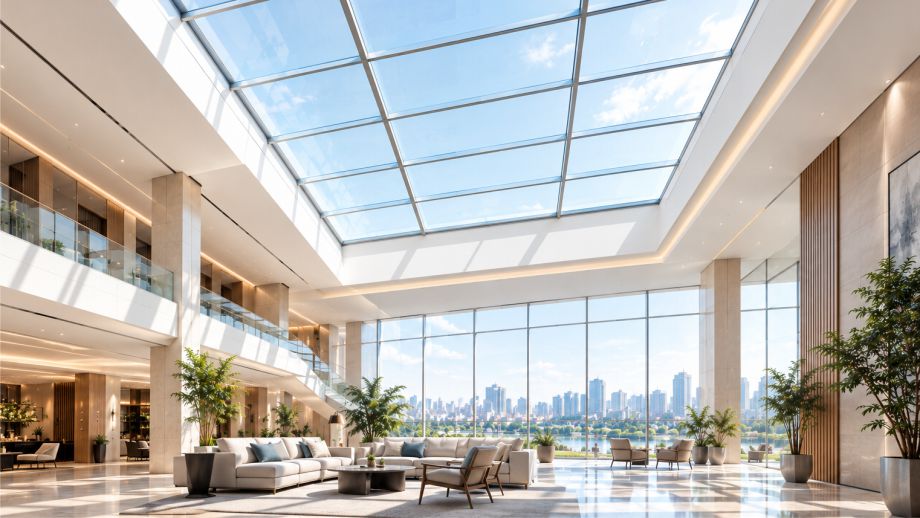
As an important architectural element for introducing natural daylight and enhancing spatial quality, skylights are increasingly used in hotel lobbies, commercial atriums, hospital waiting areas, museum galleries, luxury residences, and other high-end architectural spaces.
However, when conventional insulating glass units (IGUs) are installed horizontally, stronger gas convection within the insulating cavity can increase heat transfer. This can reduce the thermal insulation performance of conventional IGUs in skylight applications and may contribute to higher heat gain in summer, heat loss in winter, and an increased risk of condensation under suitable environmental conditions.
LandVac Titanium Vacuum Glass, or VIG, addresses these challenges through the physical characteristics of its vacuum cavity, where gas convection is largely eliminated. As a result, vacuum glazing is far less sensitive to orientation-related convection effects than conventional gas-filled insulating glass.
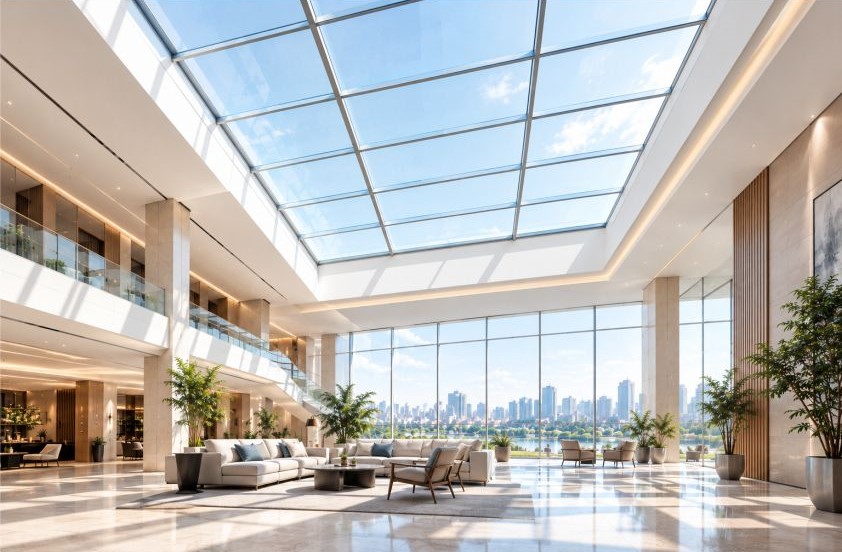
Combined with a vacuum + laminated composite structure and flexible titanium edge-sealing technology, LandVac Titanium Vacuum Glass provides a glazing solution for skylights that combines thermal insulation, condensation-risk reduction, safety, slim construction, structural strength, and adaptability to different climates.
These characteristics make vacuum glazing a high-performance option for demanding skylight applications.
Q1: Why does the thermal insulation performance of conventional insulating glass decrease when used in skylights? What are the advantages of vacuum glass for skylights?
When an insulating glass unit is installed horizontally, the gas inside the insulating cavity can develop stronger convection currents as it is heated. Heat is transferred more rapidly from the warmer lower surface toward the cooler upper surface, increasing the U-value of the glazing. This is one of the key reasons why conventional gas-filled IGUs can show higher U-values when used in horizontal skylight applications.
Test data
A conventional 6 mm + 12A + 6 mm argon-filled coated insulating glass unit was tested in different installation orientations.
Vertical installation: U-value of 1.45 W/(m²·K)
Horizontal installation: U-value increased to 2.14 W/(m²·K)
U-value increased by approximately 48% from the vertical to the horizontal installation condition.
Five advantages of vacuum glass for skylights
1. High energy efficiency with stable thermal performance
Depending on the glass configuration, Low-E coating and test conditions, vacuum glazing can achieve U-values as low as 0.3 W/(m²·K). Its thermal insulation performance can be approximately 2–4 times better than that of conventional insulating glass in comparable configurations.
Because the vacuum cavity is maintained at very low pressure, gas convection within the cavity is largely eliminated. As a result, vacuum glazing is far less sensitive to orientation-related convection effects than conventional gas-filled insulating glass, helping maintain consistent thermal performance in horizontal skylight applications.
2. Condensation-risk reduction
The vacuum cavity is maintained at very low pressure, with very limited residual gas and moisture. Meanwhile, the improved thermal insulation of the glazing helps maintain the interior glass surface at a temperature closer to the indoor environment.
This can reduce the risk of condensation under appropriate environmental conditions and makes vacuum glazing suitable for applications such as hospitals, schools, museums, and other buildings where indoor humidity and environmental stability are important considerations.
3. Safety and wind-load resistance
LandVac uses a vacuum + laminated composite structure for skylight applications. In the event of glass breakage, the PVB interlayer helps retain broken glass fragments and can reduce the risk of falling fragments, subject to the specific glass configuration and applicable safety requirements.
A tempered glass substrate provides high structural strength. In a specific LandVac configuration, wind-pressure resistance of up to 7200 Pa has been demonstrated in testing.
4. Slim and lightweight construction
An 8.3 mm LandVac vacuum glass configuration can provide high thermal insulation performance in a substantially thinner glazing build-up than many conventional multi-pane systems. Depending on the glass composition and comparison basis, it can also reduce glazing weight compared with typical triple-glazed configurations.
Its slim construction can help reduce glazing weight and the associated structural load on a building.
5. Adaptability to different climates and applications
Vacuum glazing can be applied across a wide range of climatic conditions, including hot and humid, cold and high-altitude environments, provided that the glazing configuration and installation design are appropriate for the project requirements.
Depending on project requirements, glazing configurations can be customized with options such as Low-E coatings, insulating cavities, and different laminated structures to meet specific climatic, thermal, and architectural requirements.
Q2: How much energy can vacuum glass skylights save?
Vacuum glass skylights can improve thermal control and help reduce heat transfer through the glazing. However, the actual impact on cooling demand depends on the skylight area, solar exposure, climate, building envelope, HVAC system, glazing configuration and operating conditions.
Comparative test data
A comparative experiment simulating solar radiation on skylight glazing was conducted at 21 time points between 9:31 and 16:01.
During the heating stage:
The temperature inside the test chamber with conventional insulating glass was approximately 1.0–2.5°C higher than that with vacuum glass on average.
The maximum temperature difference reached 2.53°C.
During the hottest period:
At approximately 2:00 p.m., the maximum temperature difference reached 2.78°C.
During the cooling stage:
The temperature reduction of the vacuum-glass test chamber was 1.35°C smaller than that of the conventional insulating-glass test chamber.
The overall daily temperature fluctuation was reduced by approximately 8%.
The comparative test results represent the tested setup and conditions and should not be interpreted as direct whole-building energy savings.
For large-volume spaces such as hotel lobbies, hospital atriums, and commercial atriums, improved thermal performance of skylight glazing can contribute to lower HVAC loads. The actual energy-saving effect will depend on the building design, climate, skylight area, orientation, glazing properties, HVAC system and operating conditions.
Q3: Are vacuum glass skylights safe? Will the glass fall if it breaks?
LandVac vacuum glass skylights can be designed with a vacuum + laminated composite structure. In the event of glass breakage, the PVB interlayer helps retain broken glass fragments and can reduce the risk of falling fragments, subject to the specific glass configuration and applicable safety requirements.
Key safety features
1. Tempered glass substrate
The glass substrate is tempered. A specific LandVac configuration has achieved wind-pressure resistance of up to 7200 Pa in ATI testing. Actual design loads depend on the glass configuration, dimensions, support conditions and project-specific requirements.
2. Flexible titanium metal edge sealing
LandVac’s flexible titanium metal edge-sealing technology is designed to accommodate thermal and mechanical stresses while maintaining the integrity of the vacuum cavity.
3. Long-term durability testing
LandVac Titanium Vacuum Glass has undergone 22,500 hours of accelerated ageing testing, providing supporting evidence of durability and performance stability under the specified test conditions.
Why Choose Vacuum Glass for Skylights?
Driven by increasingly stringent energy-efficiency requirements and the demand for higher-quality architecture, skylights are no longer simply architectural elements for introducing natural daylight. They are functional parts of the building envelope that must balance energy efficiency, thermal comfort, condensation risk, and safety.
LandVac Titanium Vacuum Glass combines the thermal insulation benefits of a very low-pressure vacuum cavity, flexible titanium metal edge sealing, and the safety advantages of a vacuum + laminated composite structure.
With its slim profile, high thermal insulation performance, structural strength and adaptability to different climatic conditions, LandVac Titanium Vacuum Glass provides a glazing option for skylights and other overhead glazing applications where thermal performance, daylight, safety and limited build-up thickness are important design considerations.
Website: www.landvac.net