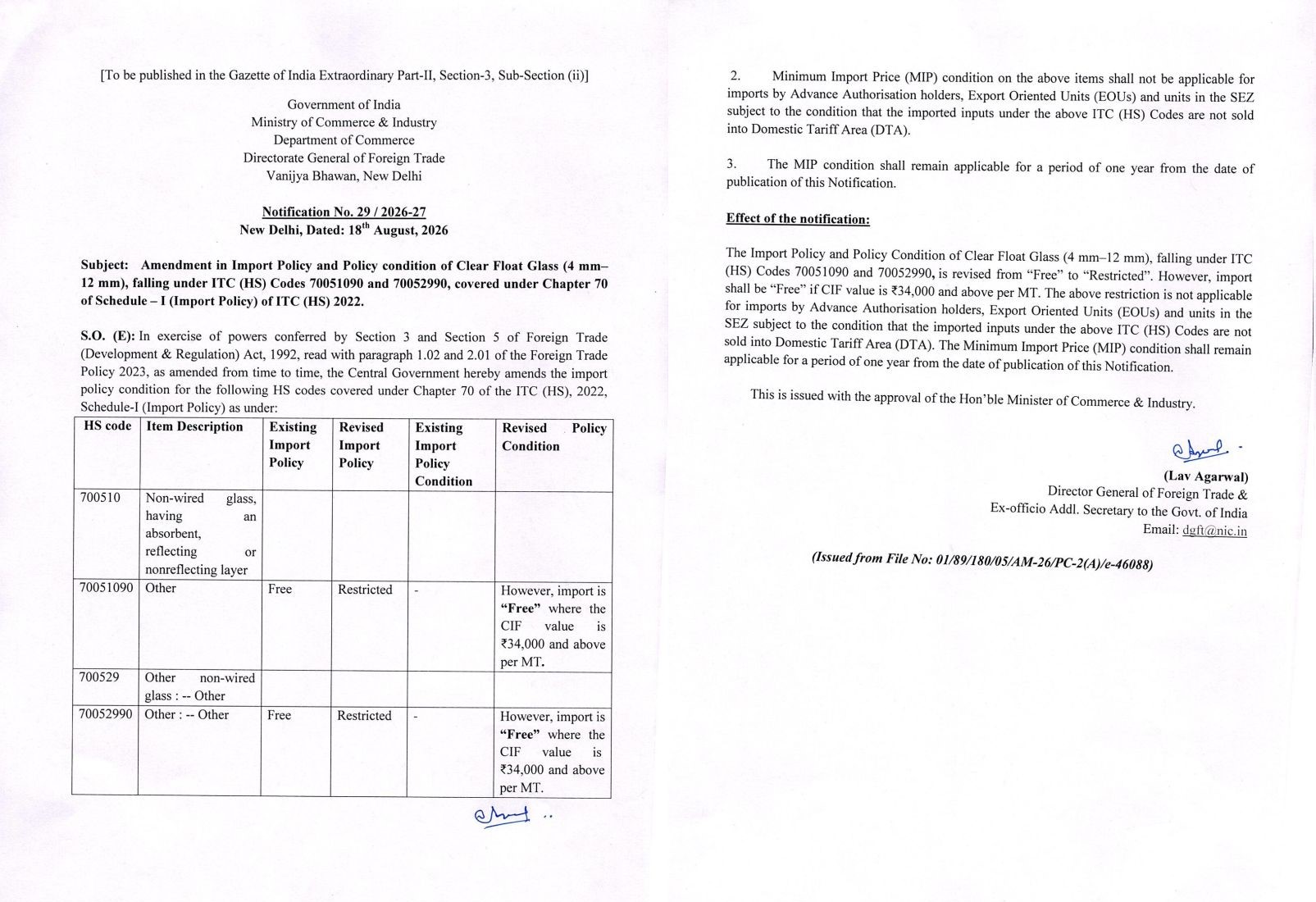
Major Policy Move to Curb Low-Priced Imports and Strengthen Domestic Glass Manufacturing
New Delhi, 18 August 2026: In a major development for the Indian glass industry, the Government of India has imposed a Minimum Import Price (MIP) of ₹34,000 per metric tonne on specified clear float glass, effective from 18 August 2026.
The decision, notified by the Directorate General of Foreign Trade (DGFT) through Notification No. 29/2026-27 dated 18 August 2026, changes the import policy for specified clear float glass from “Free” to “Restricted.” The measure is aimed at addressing concerns over low-priced imports and providing a more level playing field for domestic float glass manufacturers.
₹34,000 per Metric Tonne – What Does It Mean?
For the benefit of glass processors, traders and other industry stakeholders, the MIP can be understood through a simple calculation.
₹34,000 per metric tonne ÷ 400 = ₹85
Therefore, the MIP is approximately equivalent to:
₹85 per sq. metre per mm of glass thickness
This provides an easy benchmark for understanding the ₹34,000/MT MIP at different glass thicknesses.
For example:
- 4 mm: ₹85 × 4 = ₹340 per sq. metre
- 5 mm: ₹85 × 5 = ₹425 per sq. metre
- 6 mm: ₹85 × 6 = ₹510 per sq. metre
- 8 mm: ₹85 × 8 = ₹680 per sq. metre
- 10 mm: ₹85 × 10 = ₹850 per sq. metre
- 12 mm: ₹85 × 12 = ₹1,020 per sq. metre
This simple calculation helps processors and traders quickly understand the approximate MIP benchmark in terms of the glass they actually purchase and process.
In simple terms, ₹34,000/MT translates to approximately ₹85 per mm thickness per sq. metre.
Significant Relief for Domestic Manufacturers
The announcement is being viewed as a significant development by India’s domestic float glass manufacturers, who have been facing increasing competition from lower-priced imported glass.
The Indian flat glass industry has made substantial investments in new manufacturing capacities, technology, energy efficiency and value-added products. Industry stakeholders have repeatedly highlighted the need for a stable and fair competitive environment to support these investments.
The introduction of the ₹34,000/MT floor is expected to reduce pressure from exceptionally low-priced imports and provide greater visibility to domestic manufacturers for capacity utilization and future investment.
Impact on Glass Processors
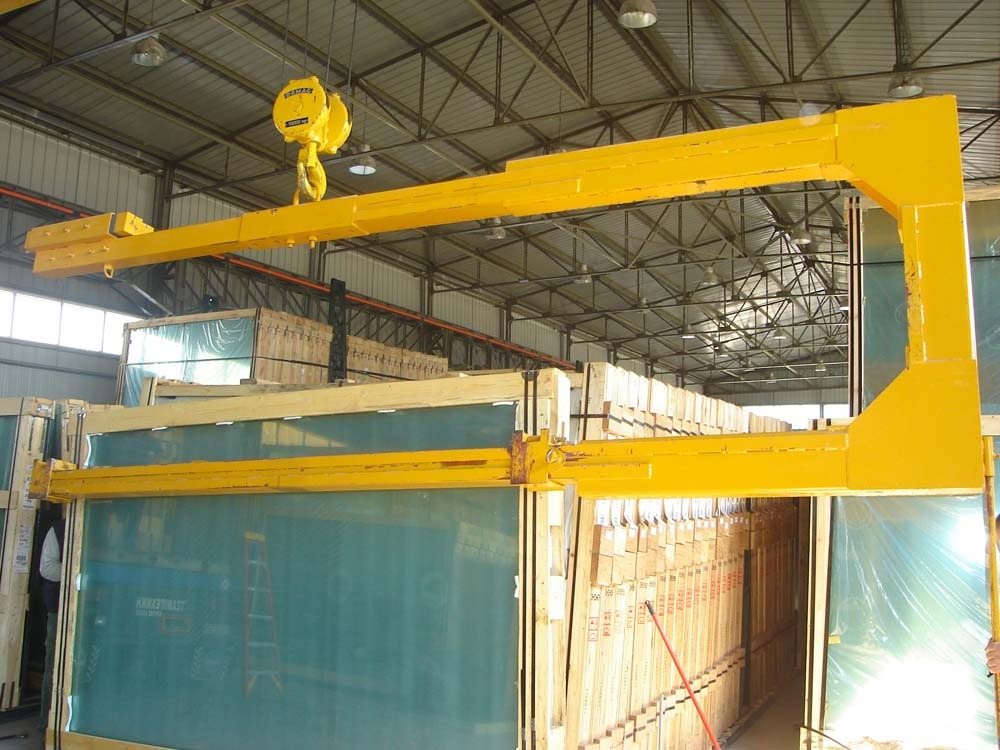
The policy will also be closely watched by the downstream glass-processing industry. India’s processors manufacture toughened, laminated, insulated, coated, decorative and other value-added glass products, with float glass being a key raw material.
The MIP may influence the procurement cost of imported float glass. However, a stronger domestic manufacturing base could also provide greater supply-chain stability and encourage investment in India’s processing sector.
Processors and importers will need to consider the MIP along with freight, insurance, customs duties, taxes and other applicable costs when calculating the final landed cost of imported glass.
Not an Import Ban
It is important to clarify that the Government has not imposed a complete ban on clear float glass imports.
The policy establishes a price-based restriction. Imports meeting the prescribed ₹34,000 per metric tonne CIF threshold remain permissible, while imports below the threshold are subject to the restricted import regime.
One-Year Applicability
The MIP measure is applicable for one year from the date of publication of the DGFT notification, unless it is modified, extended or withdrawn by the Government earlier.
The policy covers specified clear float glass in the notified thickness range and applicable ITC (HS) codes.
Industry Outlook
The decision comes at a time when India’s demand for flat glass continues to grow, driven by construction, infrastructure, real estate, façades, fenestration, solar energy and other applications.
The MIP could provide greater stability to the domestic float glass manufacturing sector and encourage further investments in capacity, technology and value-added glass products.
Lakhan Singh, Editor & Publisher, Glass Bulletin, said:
“The introduction of a ₹34,000 per metric tonne MIP is a significant development for the Indian glass industry. The simple calculation of approximately ₹85 per mm thickness per square metre makes the notification easier for processors and traders to understand. We believe a stable and competitive domestic float glass industry is essential for the continued growth of India’s glass processing, façade, fenestration and infrastructure sectors.
The industry will now closely monitor the impact of the measure on import volumes, domestic float glass prices, capacity utilization, processing costs and future investments.
For India’s glass industry, the new MIP marks an important step towards creating a more balanced and sustainable market while continuing to allow legitimate imports at or above the prescribed threshold.”